

To clarify, I mean light in the ‘light & fluffy’ sense here. This recipe is a no-holding-back, high-carb, white-flour, sugary indulgence. That said, one cake, no icing, is only about 200 calories.
For me this is off piste. I have a strong tendency to take a ‘normal’ cake recipe & replace half the constituent parts with brown foods & chewy things in pursuit of health & eternal gut happiness. The yardstick for success here is often ‘they taste OK’ or ‘you can hardly tell it’s made with [spelt/rye/chia]’. Rarely are you rewarded with the same delight as only a toddler smeared from ear to ear in sticky, chocolately mess can express.
This occasion demanded guaranteed success and so it was going to be a cake recipe your granny would have recognised or nothing at all. The extra-lightness is achieved by relentlessly beating all the ingredients as they go in, falling back to the principles your granny would have tried to instil of creaming the butter & sugar, whisking the eggs & gently folding in the flour. No big secrets.
I’ll be the first to say baking is not my area of expertise but what I did learn here is what a difference following these principles makes. Many cooks & recipe books of late have tried to reassure us that you can throw all the ingredients of a basic sponge in together, mix it all up et voila, cake in no time.
While it is true that this does deliver what is indisputably a sponge cake, the difference between this & the result of following the traditional principles is profound. With the addition of a decent mixer the ‘beat everything’ principle delivered everything I hoped for. Your poor granny didn’t have that luxury I suspect.

One challenge I’ve had in the past is quantity – using a good blender needs a pretty decent quantity of mix to work. I actually made 3-4 dozen cupcakes when I followed this recipe but have given the ingredients here to make roughly a dozen. Double up & freeze half if you want to get maximum value out of your hard work & the marathon of washing up that follows.
Makes 12-ish Individual Cakes
Ingredients
- 3 eggs – weigh them!
- Butter or oil – same weight as eggs, probably 120-150g
- Sugar – your choice of colour, or replace with sweetener of your choice. Same weight as eggs or reduce by a third for a slightly less sweet cake (the banana will naturally sweeten & if you are icing there will be plenty to leave you licking your lips without over-doing it).
- Flour – again, your choice. Same weight as eggs.
- Optional: baking powder if your flour isn’t self raising (follow pack instructions for quantity)
- 50g dark chocolate
- 50g drinking chocolate or cocoa powder
- 1-2 ripe bananas, to taste
- Teaspoon vanilla essence
- Pinch salt
Equipment
- Muffin tin & cake cases
- Heat-proof bowl (to fit chocolate & butter for melting)
- If possible, electric beaters & whisk or stand mixer: this is the key to the lightness!
Method
- Break the chocolate into a heat-proof bowl with 50g of the butter.
- Melt over hot water, taking care to ensure no water gets in contact with the chocolate (this makes it take on a grainy texture from which there is no going back!). You can speed things up by ensuring everything is broken into small pieces & stirring regularly but if time is not of the essence, just leave for the steam to work its magic.
- Allow to cool to room temperature-ish (the butter will prevent the chocolate going hard).
- Place the eggs into your mixing bowl & weigh them. Make a note of this number!
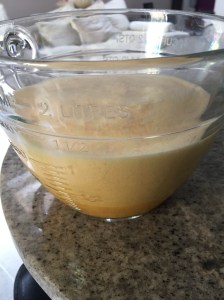
- Using the whisk attachment, whisk until super frothy. Start slowly and be patient; this will produce millions of tiny air bubbles rather than a smaller quantity of large bubbles, meaning that the whisked eggs should retain their volume for longer. This could take 5 minutes or more, just switch on & leave the wonders of modern kitchen gadgetry to work.
- This is what I mean by frothy:
- Set the eggs aside.
- Place the remaining butter or mix of butter & oil into your mixer and beat until smooth. (Skip this if using all oil. If you are using oil, make sure you pick something flavourless or a flavour you like, not likely olive oil. Avocado or a little walnut & vegetable oil might be tasty.)
- Add the sugar and continue to beat hard until the mixture is again smooth & fluffy. I don’t think you can overdo this so just switch on & get on with something else for 5 minutes.
- Slowly pour in the cooled chocolate & butter mixture with the beater running. Again, beat until well combined.
- Add the vanilla essence & pinch of salt.
- Give the eggs another quick whisk if they have flattened a little. Slowly pour these into the mixture, with the beater running. Beat until combined but no need to keep beating too long – you should now have the most air you are going to have in your mixture. The task is to lose as little as possible when adding the flour.
- To maximise your chances of keeping all the air, take the time to sift the flour with a fine sieve if you have one. Sift it onto a wide surface – if you sift into a narrow bowl the weight of the flour on top will immediately squash air from the bit you sifted first. A sheet of greaseproof paper is ideal as you can then use this to funnel it in to the mixing bowl. If sifting a large quantity, do it in batches to avoid the same problem of weight squashing air out of the bottom as you try to add it to the top.
- Sift the cocoa powder at the same time.
- The time for the electric gadgets is over. Grab a large metal spoon and your mixture. One or two spoonfuls at a time, gently fold the flour & cocoa powder in to the mixture. (Sprinkle the flour on top, run the spoon gently but meaningfully round the edge of the bowl, ‘fold’ over as you complete the circuit and cut the spoon through the middle of the mixture.) To minimise the amount of mixes, there is no need to keep folding until each and every spoon is completely combined, as soon as one spoonful is well distributed start on the next.
- Keep folding until all the flour is in and no traces of flour remain but stop as soon as you reach this point.
- Optionally, add an extra roughly chopped ripe banana at this point. Remember to follow the same folding technique – Operation Retain Air can’t fail at this late hour! I was tempted to add chocolate chips but I think this would render all the efforts to make the lightest cakes ever, wasted.
- Put a muffin case in each space in your muffin tin and begin to fill each evenly. Two long coffee spoons came in handy here – small enough to ensure the mixture went straight into the middle of each case but avoiding the sticky handles that teaspoons usually end up with.
- Place in a hot-ish oven (180c) for about 20 minutes, depending on the size of your cakes. Keep an eye on them and use the knife-comes-out-clean test to check they are cooked. (Don’t stress about cakes loosing height if you open the oven, I’ve usually found this unnecessary stress.) ‘Clean’ should mean just a little glisten on the knife – the warmth of the cakes will keep them cooking a little after you take them out so if you wait until they are completely cooked before removing from the oven, you risk them being dry in the end.
- Allow to cool completely before icing, or just eat naked as they are. (The cakes naked, not you.)
Find the Chocolate Cream Cheese Icing here.
 Save-it Sarah's Off Piste Recipes