
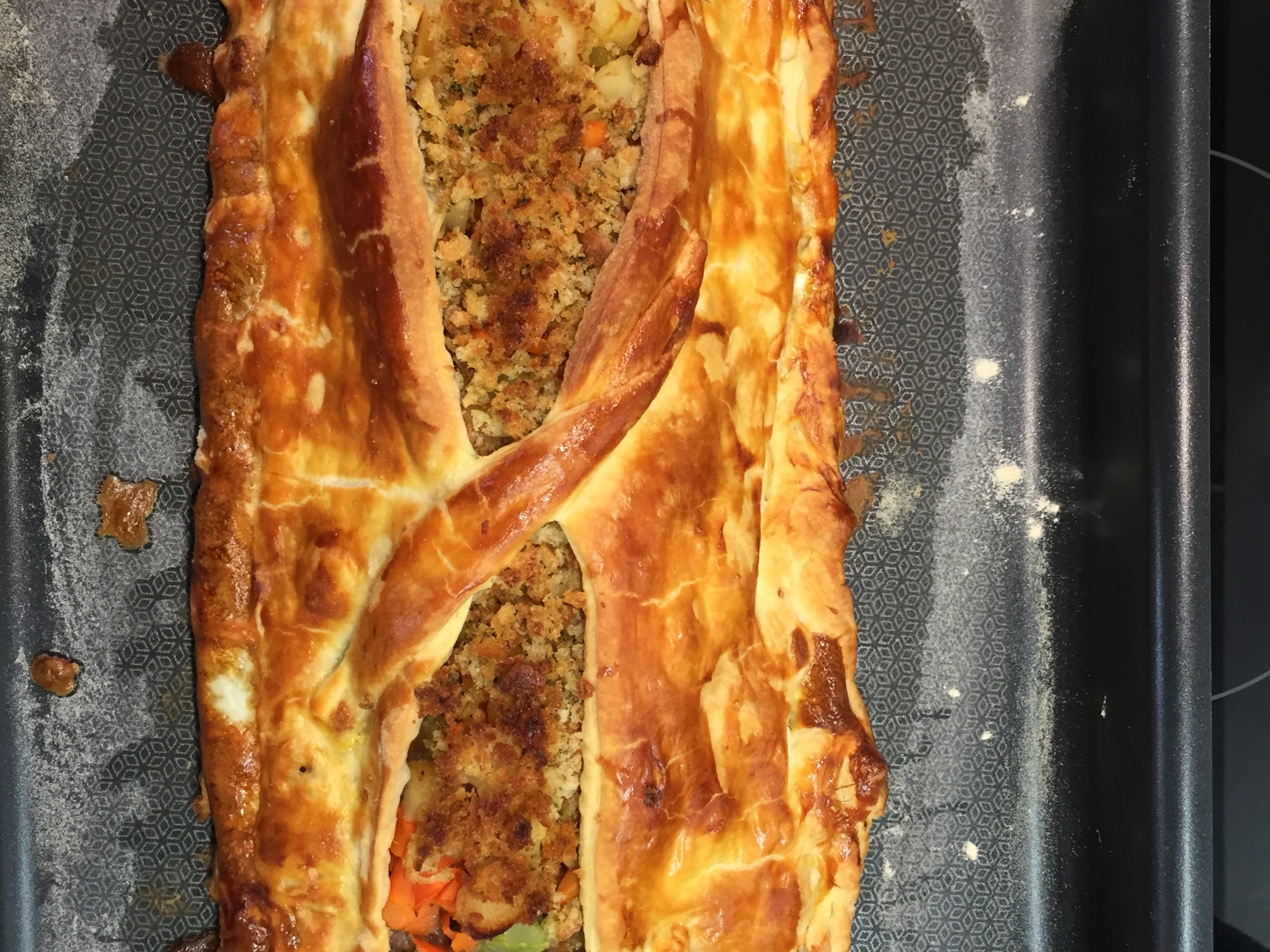
This recipe is more a concept than a strict set of instructions. It can be adapted to use up a whole range of left over meat & veg or could easily be made from scratch if you fancy it.
The principle is basically to get a meat & veg combination which is neither too wet nor too dry – think sausage roll. So just chopped turkey would probably be too dry, too much mashed veg too wet. Chose a layer of sauce for the base that matches your primary meat – cranberry or red currant goes with most traditional Christmas fayre.
It could also easily be made as a vegetarian option – I think it would work fine with say a sage & onion stuffing as long as the stuffing isn’t too wet. You might want to mix in something like cooked pearl barely if taking this option, just to give a bit of bite.
Finally, if like me you think you have more filling than your pastry can comfortably take (it needs a good 2cm seal between the filling & the edge else it will seep out), make up some bread crumbs and use these as a sort of crumble topping for the gap.
I added some fresh herbs to my stale bread & blended in a few dots of butter (else the bread will just burn in the oven). Have the ‘no pastry cover’ section on top (so that the edges get their full seal as a priority) and cover this with bread crumbs before putting any pastry on top – filling gaps retrospectively will be fiddly & a bit more messy. Thinking ahead slightly by looking at the amount of pastry & filling you have and considering the size of your tray will help avoid any last minute panics.
Remember to fill your pastry on the sheet you plan to cook it on – it will be impossible to move raw pastry once covered in filling.
If your baking sheet has sides, see my tips page for how to get the finished parcel off the tray without breaking it.
Serve with salad for lunch or with more roast veg & gravy for a more hearty supper.
Serves 6-8.
Ingredients
| Pack Ready rolled puff pastry | 1 | ||
| Leftover meat or stuffing | Enough to serve your intended crowd | ||
| Left over gravy | 2 | tablespoons | Optional, to moisten the meat mixture |
| Cooked Vegetables | Carrot, celery, celeriac, parsnip…chestnuts work too. Anything reasonably soft. | ||
| Cranberry Sauce | 2 | tablespoons | Or other sauce to match your filling |
| Bread Crumbs | 100 | grams | Stale bread made into coarse crumbs |
| Butter | 20 | grams | |
| Fresh Herbs | 1 | handful | Optional; Sage & parsley worked well |
| Milk | 1 | tablespoon | |
| Egg | 1 | For a glazed finish |
Main Equipment
- Approx 40x30cm baking sheet
- Rolling pin (or wine bottle!)
- Food processor to make bread crumbs (grating or roughly chopping will work if you don’t have a processor)
- Pastry brush – can manage with a teaspoon but brush is better
Method
- Check your pastry pack instructions- most need 20 minutes at room temperature before use. Too long out of the fridge and it will tear easily when you try to move it around, too little and it won’t roll at all.
- Roll out your pastry on a floured surface. Cut a rectangle for the base, judging enough to get most of your filling in a maximum of a thumb’s depth layer with a 2cm gap all round, while reserving at least enough pastry to cover about a third of the top. The bread crumb-gap filling trick can only stretch so far. You can roll even ready-rolled pastry to stretch a little more out of it.
- Grease & lightly flour your baking tray.
- Place your base pastry on the tray.
- Dot the cranberry sauce along the length of the pastry before spreading – remembering the 2cm gap on all sides. Dotting before spreading minimises the risk of tearing the pastry whilst spreading the sauce.
- Mix any gravy (cold) you are using with your meat to get a moist but not soggy mixture. Doesn’t look attractive but doesn’t need too.
- Dot & spread the meat mixture along the pastry as before.
- Layer over the veg – remembering how much pastry you have for the top and hence not making the filling too deep.
- If using bread crumbs to make up the pastry shortfall, whizz up stale bread crumbs in a blender to make coarse crumbs. Add the fresh herbs & blend again. Then dot in the butter & blend briefly to distribute the butter, just like making a crumble topping.
- Sprinkle the bread crumbs on the area you expect to be exposed.
- Brush the pastry border of your base with milk to help it seal to the top.
- Roll out your pastry for the top on a floured surface, cutting sections as necessary.
- Lay your pastry top sections over the base & pinch along the sides to form a seal. Use both thumbs for this & work your way along each edge, gently pushing little sections of pastry between the tips of your thumbs.
- Use any stray bits of pastry to decorate the top – brushing with milk to get them to stick.
- Brush the pastry with beaten egg.
- Place the tray on the bottom of a hot oven – about 200-220c. The filling is all cooked so just need to crisp up the pastry. Putting it on the base of he oven was a tip I picked up recently to avoid a soggy pastry bottom – worked a treat.
- Remove from the oven & cool slightly before moving to a board or serving plate. See Moving a Large Pie or Tart from a Baking Tray.
 Save-it Sarah's Off Piste Recipes